Showing posts with label Musings & philosophy. Show all posts

Monday, 16 August 2021

Aldous Huxley recording: The Ultimate Revolution

 The great twentieth century literary figure and thinker Aldous Huxley should need no introduction. He is most famous for his dystopian novel Brave New World (1932), in which he imagines a society, prophetically when we consider the contemporary world and where it is going, under a form of 'soft' dictatorship, in which suffering has been 'banished' through medication, and types of people are conceived and brought up artificially to fulfull ideologically defined roles. It is a 'comfortable' world, in which individual freedom has been confiscated, and responsibility abdicated. Sound familiar?

In this recording, made in front of an audience on March 20th 1962 at Berkeley Language Center in the United States, he goes back over his dystopian work, comparing it to Orwell's 1984, which he admires greatly. However, he feels that the future forms of dictatorship will not be Orwell's 'terroristic' ones, a vision influenced by the recent context of its composition, world war, Nazism, and Stalinism, but a 'soft' one something in line with his own prediction. This will be enabled by the advances of technology combined with the modern media, biotechnology and pharmacological methods, making people, as he says, 'love their servitude':

 “There will be, in the next generation or so, a pharmacological method of making people love their servitude, and producing dictatorship without tears, so to speak, producing a kind of painless concentration camp for entire societies, so that people will in fact have their liberties taken away from them, but will rather enjoy it, because they will be distracted from any desire to rebel by propaganda or brainwashing, or brainwashing enhanced by pharmacological methods. And this seems to be the final revolution.”

Click on the link below to acces the 44 minute recording. He also considers the future influence of automation, and transhumanism. All in 1960! 

Thursday, 25 March 2021

Charles Williams on Poetry

 One of my all-time favourite figures in the literary world of the last century is Charles Williams. For some, for very few, he needs no introduction, but he has been obscured by his more famous friends, J.R.R. Tolkien and C.S. Lewis. Together, with other extraordinary people, notably Owen Barfield who died relatively recently, they formed a group called The Inklings in Oxford during the nineteen thirties and forties. These men met in each others' homes to discuss literary and philosophical matters, and read out their own work before publication. C.S. Lewis would read from his novels and religious and philosophical writings, Tolkien from the later-to-be-published The Hobbit and The Lord of the Rings. They would also meet up in an Oxford pub 'The Eagle and Child' (a wonderful place I recommend) over a few pints of the best English ale.

As for Charles Williams, the least formally 'educated' of the group, and from the most modest background, he worked for the Oxford University Press (at the time they would place the definite article in front of OUP) as editor, writer and critic. He was a singular and remarkable poet himself, and wrote a series of extraordinary novels, seven in total, which bring the supernatural into the everyday world of England. I would strongly recommend them, they were popular in their day, T.S. Eliot encouraged his writing, and they stand as a monument to a remarkable mind. They are: War in Heaven, Many Dimensions, The Place of the Lion, The Greater Trumps, Shadows of Ecstasy, Descent into Hell, and All Hallow's Eve. 

He wrote plays too, and books of literary criticism (for want of a better term; I prefer 'reflection'), and I recently found a first edition from 1932 which I am thoroughly enjoying. As with most of Williams' prose, it is curious in style, dense and challenging in its insights. This one is called The English Poetic Mind, in which he attempts to define, or at least touch upon, what characterises this phenomenon, looking in particular at Wordsworth, Shakespeare and Milton. I have scanned below a section from the opening, "What makes great poetry', in which he quotes Wordsworth's insights into poetic creation. For the Romantic poet, it needs 1) 'the vital soul' 2) 'general truths' 3) 'external things - Forms, images'. Williams expands upon this, by saying that the great poets 'arouse in us an actual sense of our own faculties' for such things as heroism, love, exile, although these things may be alien to or limited in us. This makes me think of the poem 'Anthem for Doomed Youth' by the War Poet Wilfred Owen, which we have been looking at in class recently. We could not possibly understand the terrible experience of trench warfare ourselves, but the poem awakens in us a deep sympathy, and at least shades of understanding, however distant, and in some sense we are connected to the young men who suffered and died during this conflict. 

Below you will find the link to the extract from Williams' book:

Monday, 19 October 2020

Tradition - The symbol of the Tree

In class we often, necessarily, talk of tradition. The knee-jerk reaction might be rejection of tradition because, throughout history, those embodying forms of tradition have often abused positions of power in its name. But we are talking about something quite different here. It is not dusty and fuddy-duddy, blocking the way for us to the newness and freshness we all long for. Quite the opposite.

There are archetypal patterns, symbols, some of them shared by the whole of humanity. We are born into a world which is Nature itself, our own bodies firstly; and Nature, the rain, storms, cloudy skies, birdsong, sunrise, are among our very first impressions, and accompany us all throughout our lives, in joyful and harder times. They speak to us deeply, on deeper levels than we can really, fully articulate, and the artists naturally turn to this primordial language. So we might define tradition as the universal 'language' which speaks to us because it conforms to or reflects our unchanging inner natures as human beings. 

This language can take the form of story, legend, myth, such as the myths of Creation, the Fall of Man, Divine vengeance, the Flood, the great Quest of the Holy Grail, or the journeys across the seas, tales of exile and return to the kingdom. These narratives underpin many if not most of our great stories and dramas, because they are the eternal blueprint of what our lives actually are, unfolding in time as narrative, and encountering the storms and clear skies of all voyages. We all begin at home, leave, and in some way return. These stages, or phases, might be related to location, or not. Whatever they are, we all experience them as feeling, impression, sensation, intuition.

I don't think any great artists can be disconnected from tradition. They may react against it, as was the case of the Modernists, but that was in the knowledge of what they were reacting against.

Below is an extract from Northrop Frye's The Great Code, a brilliant study of biblical language, image and story, in relation to other traditions. This part concerns the networks of meaning related to the tree. They include of course the cross, as demonic image and image of salvation, Adam, Jack and the Beanstalk, the Hanged Man of the Tarot pack.

What could be more primordial than the tree, symbolically, and literally? It gives shade to man and animal, it is a habitat for millions of creatures, its roots burrow deep into the earth as we need roots, it stands vertically as we stand, 'dressé vers le Ciel', as Rémi Brague describes mankind's unique stance on the Earth in his remarkable study of our place in the Cosmos: https://www.amazon.fr/Sagesse-monde-Histoire-lexp%C3%A9rience-lunivers/dp/2253943223/ref=sr_1_7?__mk_fr_FR=%C3%85M%C3%85%C5%BD%C3%95%C3%91&dchild=1&keywords=remi+brague&qid=1603101585&sr=8-7

and its branches recall our hair, or can be the mirror image of the roots in the Earth but crisscrossing the sky.

Click on the link below to access the Frye document in pdf form:

Sunday, 24 May 2020

'Passage to Modernity' - evolution of the self, of language, and literary forms

In previous posts I have published thoughts on artistic creation from philosophers and poets. What interests me in particular is the evolution in our sense of selfhood over the centuries; because how we conceive of ourselves today is radically different from how our ancestors did, in the Classical world, in the Medieval Age, the Renaissance and the Early Modern period. It can be enriching to think of these things, because they allow us to see our own confused and difficult times perhaps at one remove, putting them in healthy perspective.
It is difficult to introduce such thinking without making inaccurate generalisations. Yet we could say that in ancient societies there existed a sense of the self not just in relation to itself, or the collective, but the cosmic; that the individual was not seen as a discete, atomistic entity with its private desires and concerns in isolation, but as a part of a cosmic whole, with its God or pantheon of gods, its mythologies, its cosmologies, cosmogonies, astronomy and astrology, and its ancestors. When we read poetry, epic or shorter poems, watch plays or read novels, rarely do we see these phenomena as quite unique and special, and lying within a long evolution of the human story. Shakespeare seen in this way is revolutionary, Hamlet, hugely modern, the novel, a recent invention inconceivable until relatively recent times. The question is, Why?
The modern period is characterised by the increased significance given to the individual, while the cosmic sense has withdrawn entirely, to leave mankind thrown back upon himself, with quite different existential and artistic questions from before. 
The extract below, from Louis Dupré's excellent work Passage to Modernity (1993, Yale University), traces, from this wide perspective, the ways in which our sense of self and the world have changed, and thereby changed the very literary forms we now take for granted. 
Dupré also, necessarily, considers how our conception of language itself has changed fundamentally with this shift towards the discrete individual.
Dupré's is dense thinking, but wonderful to grasp. I think that giving it time and staying carefully with it can reap very great rewards!
Click on the link below to download the pdf document:

Monday, 13 April 2020

The Culture of Modernity - Charles Taylor (HK/KH)

In a much earlier post, I put up a chapter from the Canadian philosopher Charles Taylor's excellent work, Sources of the Self. I have chosen another chapter to put on line for you, which I think is particularly interesting and useful, from a literary point of view. It comes in the middle of a long enquiry into the evolution of a sense of self, from the Middle Ages to this point in his study: the eighteenth century. So it might not be fully understandable at the outset. Be patient, it is a good read! And Taylor has the virtue of being clear and intellectually integral.
His approach here is quite literary, because he refers to the growing trend and development of the novel at this time, particularly in Britain, but with references to France, for example Rousseau's La Nouvelle Héloïse. He mentions Pamela (1740) and Clarissa (1748), two epistolary novels (a fashionable form at the time) by Samuel Richardson, and of course Daniel Defoe's works, which all embodied the new sense of importance given to 'sentiment', and the moral value of 'noble and good' sentiment within the context of relationship, especially marriage. It was also the time in which greater validity was given to childhood, as a distinct period in life. We can see future elements of Romanticism in embryonic form.
Upmost in this thinking is the growth of the private sphere, along with the importance given to 'the ordinary life', all of which we now take for granted. He articulates this as a major shift from 'archetypal' vision to the subject being the locus of meaning, particularly in its quality of instrumental, reasoning subject. The new understanding replaces the traditional cosmology based on hierarchy. Whereas before (and we can see this in Shakespeare) Nature corresponded to and found an echo in human being through a cosmology structured around hierarchies which could be disrupted, now what counts is the effect Nature has on us, the locus of feeling, and the way it reflects our feelings, our mood. This developed over a long period, and the novel, with its attention to the detail of ordinary life, expressed and reinforced this.

You will find the chapter by clicking on the link below:

Saturday, 4 April 2020

Owen Barfield on poetic language (Kh/HK)

Here are some interesting thoughts by Owen Barfield, friend of Tolkien and C. S. Lewis, and one of the Inklings. This chapter, ‘Language and Poetry’, comes from his major, highly influential work Poetic Diction: A Study of Meaning.

Barfield here considers the stages through which poetry and poetic vision have passed, and the accompanying changes in language and thought. He begins, in a necessarily simplistic way, with the ‘concrete vocabulary’ of the world’s first mythologies, to Greek mythology as vector of meaning alongside living Nature, to the language of modernity. 

Particularly interesting are his remarks on the ancient Greek language of Homer being ‘looser’ than our more usual ‘architectural’ linguistic and poetic forms: ‘a living, muscular organism rather than as a structure...’. This move from an ‘organic’, ‘fluid’ type of poetry to the ‘architectural’ he places more or less in English from the seventeenth century onwards, for instance in Milton and the Metaphysicals, not so much in Chaucer or Shakespeare. The more ‘fluid’ types of verse are made for reciting, the more ‘architectural’, for reading, for seeing on the page.

He draws out the inherent tension between the ‘rational’ and the ‘poetic’ in the history of poetic utterance; the ‘rational, abstracting, formal principle’ and the ‘primal flow of meaning’. It is surely in a great poet like Shakespeare that we find the perfect balance; the great intelligence of an organising principle working with the ‘flow’ of life.

Compare the extracts of Shakespeare we have studied with Milton or John Donne, for example. The seventeenth century really is a watershed. Think of Milton's highly elaborate poetic architecture, the latinate syntax. I think in the twentieth century T. S. Eliot gave much thought to this, and brought back in a modern way the organic forms of poetic utterance in the context of Modernism.

Click here to download the chapter in pdf format:

Thursday, 16 January 2020

Victor Frankl: Man's Search for Meaning

This perhaps has nothing ostensibly to do with literature, and shouldn't be on a literary blog... But no matter. In fact, I think it does, and should, because our search for meaning - those blessed moments of life, when we connect with something deep and fulfulling - leads us to the poets, playwrights and novelists, because they can disclose the deeper meanings to existence. This of course was the official or unofficial manifesto of the Romantics, and of most evolutions in literary production. 
So here is an extract by a remarkable man, Victor Frankl, who was a psychologist and psychoanalyst, practising in Vienna before the second world war, and because of his Jewish background, found himself, along with his family, in several concentration camps. He survived, incredibly, and this experience, as he recounts in his bestselling work Man's Search for Meaning, which I strongly recommend, did not leave him in despair, but reinforced his conviction of the ultimate meaning of our lives. It is a powerful message he translated into a new school of therapy called 'logotherapy' which he mentions in this extract of Man's Search for Ultimate Meaning. Frankl is not concerned with clever-sounding theories, but our actual lives. It is an existential approach. I think the examples he gives here are powerful. In this time of upheaval and deeply disturbing political, social and ecological developments in a more and more mechanically organised, purely profit-based society, when it is all to easy to lose sight of hope and meaning, it is salutary to consider this extraordinary voice.
Click on the link below to access the document:

Monday, 13 January 2020

Roger Scruton 1944-2020

Roger Scruton, who passed away on Sunday 12th January, was a remarkable philosopher, and one of Britain's leading intellectuals. An often controversial figure - always a healthy sign - he wrote with great integrity, and a love of wisdom. He would often lament the fact that our time has lost a sense of Beauty, and he would articulate this brilliantly, and hold up Beauty as an essential part of what it is to be human. He had, as the obituary says below, published in the magazine The Spectator, immense culture, including a love of music. He was also an accomplished pianist, and farmer.

Monday, 9 December 2019

Wendell Berry on the Land

Following on from thoughts of enclosure, Hardy's England, and country folk...Here is an interesting essay, from the other side of the Pond, by the remarkable Kentucky farmer, essayist, thinker, ecologist and poet, Wendell Berry. He is regarded by many as a visionary, but with his farmer's feet firmly on the ground. And he speaks his mind, which I like a lot. Click on the link below:

Sunday, 1 December 2019

The Land Grab (suite)

In the post below, on the Northamptonshire peasant poet John Clare, I spoke of the traumatic effect on the inhabitants of rural England of the accelerated privatisation of the Common Land of the country. John Clare himself never got over this, and some of his most moving poems were written in response. This process of Enclosure gathered pace in the eighteenth century, and later, in the Victorian Age, the novelist Thomas Hardy would depict and lament the situation of the rapid disintegration of rural communities and their ancient customs, which came about when country folk were thrown off the land. In Hardy's novels, it is common to see people walking the country roads in search of seasonal employment and habitation. Yet this process began much earlier...

Friday, 29 November 2019

Poetry and Tradition

Yesterday I gave a talk on 'Kathleen Raine and Tradition' at the Université Sorbonne Nouvelle Paris 3, with my colleague Claire Tardieu, who wrote her thesis on the poet in the 1980s. A big thank you to the Atelier Poem, chaired by Sarah Montin, who welcomed us so warmly.

Sunday, 3 November 2019

Poetry and Philosophy

Here is an excellent essay (click on the link below) written by my friend Joseph Milne, Honorary Lecturer at the University of Kent.

With great clarity, he explores the distinctive characteristics of poetry and philosophy, the inherent tensions between them, and how they complement each other as modes of knowing.

Saturday, 2 November 2019

Insurgent poets


Thank you Cécile and Stephan, for your very interesting contributions! (see comments on the Poe post below).  I’ll put a reply here. I’m not sure what Poe means by placing this story within his story. What is clear, as you have said, is that the creation of the painting has been brought about at the expense of its subject and, I would say, through the disconnection of the artist from his source of inspiration. Is Poe saying this is the nature of art itself, that it is a danger to our relationship to reality at the same time as being a representation of it ?
Poe’s imaginative world is in many ways close to Baudelaire’s. As was said in a previous post, Nature in its broadest sense, the phenomenal world, from being a place of succour for the Romantic, and in much traditional Western art before the modern age, a reflection of spirtual presence, even a theophany, has become ‘sublimated’ into an imaginative world. This imaginative world in Baudelaire becomes ‘artificial’, a place of refuge from a reality perhaps too difficult to bear, or at least too grey and one-dimensional, a place of disenchantment. In this sense, finding le fleur in or from le mal is the act of sublimating what is ugly, sinister, bleak, into a new creation - as Poe does in this story, through his description of the castle and the telling of the tale within the tale. It is an act which fails in the incipit of The Fall of the House of Usher. The narrator, facing the terrible house at the beginning of the story hopes, ‘It was possible, I reflected, that a mere different arrangement of the particulars of the scene, of the details of the picture, would be sufficient to modify, or perhaps to annihilate its capacity for sorrowful impression’. But the small lake in front of it only reflects back, inverted, the same horror. 

Thursday, 17 October 2019

Poe, Baudelaire and the break with the Romantics


Poe stands out quite starkly from his Romantic predecessors. The Romantics see Mankind as essentially good, especially the children before society has corrupted them. ‘Redemption’ would come from reconnection with Nature from which we have become estranged. Nature provides solace and strength, and epiphany lies in seeing its spiritual goodness, and the healing that can flow from it. The poets, like Wordsworth or Coleridge, wanted to show the spiritual significance of simple, even banal things by elevating the ordinary. Poe breaks radically from all this. The ordinary becomes extraordinary, and not a source of succour and goodness at all. In many ways, and this is why Baudelaire must have been so drawn to Poe, both men share a common ‘anti-Romantic’ vision. Baudelaire does not reject the spiritual, but the Rousseauian belief that man is by nature good. He admires Poe for declaring ‘the natural wickedness of man’ :

La plupart des erreurs relatives au beau naissent de la fausse conception du dix-huitième siècle relative à la morale. La nature fut prise dans ce temps-là comme base, source et type de tout bien et de tout beau possibles. La négation du péché originel ne fut pas pour peu de chose dans l’aveuglement général de cette époque...La nature ne peut conseiller que le crime… [Dans] toutes les actions et les désirs du pur homme naturel, vous ne trouverez rien que d’affreux.

(Eloge du maquillage)

Monday, 14 October 2019

Charles Taylor on the development of art - Romanticism, Modernism

Following on from considerations of the previous post, here is an extract (click on the link below) from Charles Taylor's excellent Sources of the Self (Cambridge University Press,1989). It comes in the middle of a much wider reflection on the development of subjectivity in artistic expression, but I think it is understandable on its own. It does of course need some real engagement when reading it; it is complex, and yet very clear at the same time. The overarching idea is that of the "epiphany", which is common to much art over the centuries; the opening up to a deeper meaningful dimension to life, beyond the day-to-day more one-dimensional experience we have. And why ideas of epiphany have so changed over the years. This could be religious, or in a time of unbelief, more generally a sense of transcendence, going beyond habitual limits. It might be useful to comment further on this in future posts. It does take us through some of the important shifts over time in thinking and feeling.


Sunday, 13 October 2019

Art and mutability


It is all too easy in our times, and just looking back in time, to see humanity as a blot on the landscape, our history a story of crime. The twentieth century, in spite of ideas of human progress, brought the two most terrible wars we have known. And now we are faced with new unprecedented ecological and economic disaster. What have we done, what are we doing, to the Earth and to each other? Yet, how resilient we are, how essentially loving and creative we can be, ceaselessly rebuilding in the face of all odds, creating too in the arts in spite of or perhaps because of the odds.
It has always struck me, when looking at our artistic creations, how exciting this human adventure is, and has always been, how courageous and often so beautiful. We should sometimes stop the self-flagellation and condemnation, and look at our 'monuments of magnificence', the wonder of our creations. 
Never one for seeing things in categories, I think nevertheless it is difficult not to make out grand movements, and overarching tendencies, or yearnings. Above all, the human spirit battles on: ‘I will not cease from Mental Fight’, said Blake. There may be differing, even conflicting schools of thought, points of view, especially in modern times, when unity of culture can seem all but gone. Yet we look back at the Renaissance, the Romantics and what they tried to do in all their indefinable complexity, then the Victorians, and the Modernists of the last century, each moment often opposing and upturning what had gone before - and what abundant creation resulted for us all! Often at great personal cost for the artists. But what was going on, what were the undercurrents bringing such upheavals in style, in vision? What has happened to us, what meandering, daring often tortuous paths have we taken? I am not sure, today, we are quite aware of what they exactly have been - these paths, and why we have taken them - from the isolated fragmented perspective of our time, which more than any other time in history is cut off, divorced from the traditions which have upheld our civilisation for millennia. 


Sunday, 6 October 2019

My best teacher, by Jeremy Vine

Following on from the last post. Here is a touching article published in the Times Educational Supplement written by BBC broadcaster Jeremy Vine on the occasion of the sad passing of his English teacher. Neil Laing also happened to be my best teacher, and I thought this a beautiful tribute to him, a way to say thank you. I recognise everything in it, down to his well-behaved dog in a basket by his desk! 'Laddie' Laing was a very special man. Teachers really can be...


My best teacher

What made Neil Laing such a special teacher was that he was so cool. And because he was cool he could explain Shakespeare and Marlowe and Webster and poetry to spotty teenagers who couldn't see the relevance of any of it and somehow engender great enthusiasm. We realised that you didn't have to be a wimp to enjoy things that were artistic and complicated.He had a dog called Jack who sat passively in a basket under his desk throughout lessons, never once causing any distraction. Jack was so respectful I think all of us potentially uproarious boys looked at the dog and thought if he's going to obey this guy, we certainly will. The dog was white with brown spots and long ears. Appropriately, being an English master's pet, I think he was an English setter. Neil Laing was also cool because he was married to someone who worked for The Times. His wife was a sub-editor in the days before careers officers had heard of the media.
Nobody ever tried it on in Neil Laing's lessons, and they tried it on in lots of other classes. He was an accessible, likeable person and he took me through English O- and A-levels at Epsom College. He was about 6ft, lean with a well manicured moustache, a jutting brow and a slightly intense look. He had what Tom Wolfe would describe as a lantern jaw. He was the model of courtesy, and very neat. He looked as though he had come out of a Thomas Hardy period drama.
He knew how to trigger boyhood interests by focussing on the sexual imagery in the texts we were studying. And when we were discussing King Lear, I remember him saying we needed to understand the interiors and that what goes on inside people is more important than what is on the outside. Twenty years later I still vividly remember him telling us that physical illness is a picnic compared to mental illness.
He got us reading aloud in lessons and I liked that. There is some sort of actor gene in me; my brother is a comedian and my sister an actress. But he was very cross with me once when I read Hamlet in a silly accent. My school reports always said things like: "He is clearly interested in things other than the class he is doing."
English was the only subject which spurred me and which I wasn't doing just to pass exams. I still love poetry, and it was quite an achievement to get adolescent boys not to think it was sissy. Neil Laing would go off on flights of fancy and sometimes in a class which lasted an hour, he would spend 50 minutes talking about just one line in Shakespeare. I remember once asking him whether we were reading too much into these plays, which set off a discussion that lasted a double lesson.
I didn't enjoy school. I was very bad at sport, which was humiliating in a public school culture that was very sporty. Now, I realise of course that the people who were good at sport are working as clerks in pension firms or middle managers, so their lives ended when the school bell rang for the last time, which is hugely satisfying.
I was set on a career in the media from the age of 12. I saw myself on the radio and playing records. My heroes were people like Roger Scott and Kenny Everett. When we had a careers session at school and I said I wanted to go into the media there was real shock. But Neil Laing encouraged me. He invited me round to his house to meet his wife and have a chat about her work as a journalist. And when I started playing records on the radio station at the local psychiatric hospital in Banstead once a week, he thought it was a great idea to get cracking early.
Neil Laing had absolutely the right balance as a teacher between the chummy and the personal, and the authoritative, which is a difficult balance to get. I owe him and never told him, and this is a great opportunity to do so.


Broadcaster Jeremy Vine was talking to Pamela Coleman
Published in the Times Educational Supplement Newspaper on 11 August, 2006

Wednesday, 2 October 2019

Graeber (suite)

As a follow-up to the reflections on the world of work by Dickens in previous posts, on his Circumlocution Office, Coketown, and David Graeber, a friend put me on to this BBC Radio 4 broadcast, one of a series of three about the changing landscape of the modern world of work. The interviews are interesting, Graeber himself speaks, as do the hordes of people on their way to the office in the morning. What are we doing with our lives? A healthy question to ask.


From the site:
"What do we want from work? Millions of people are now reinventing their working lives. Ruth Barnes presents the first in a new series exploring the changing world of work.

There are now five million self-employed people in the UK, it’s the fastest-growing group of workers. Sometimes it's a case of "needs must" as conventional industries collapse - but the evidence suggests that most are doing it because they want to, they see themselves as breaking free.

The internet is full of inspirational talks from the late Steve Jobs and others, exhorting us to take risks, set out on our own, make our fortune. But with the average freelancer earning only £240 a week - about half the earnings of the average employee - what is the price of freedom?

In this first programme, Breaking Free, Ruth hears from people who have reinvented their working lives, becoming taxi drivers, brewers or cleaners. She talks to David Graeber, an anthropology professor who tapped into something really big when he published his book 'Bullshit Jobs'."


Sunday, 29 September 2019

Tolkien and Fantasy

  Many people love the world of Fantasy, of impossible, 'unreal' things, beings, happenings. A childhood without magical stories is surely a childhood bereft of some of its greatest treasures. Those ogres, beanstalks, forests and wolves, the alluring cottage made of gingerbread, cakes and candy in Hansel and Gretel, shiny poisoned apples...Never trust appearances...The adult who 'grows out of it' needs perhaps more to think about growing back in. These great characters, events and places seem always to have been there, as we connect, or reconnect, with a lost sense of wonder. They work too as grand archetypes whose meaning is at once immediate and yet ungraspable by the rational mind.

Saturday, 21 September 2019

Romanticism

I would like to share some of the English philosopher Roger Scruton's thoughts on Romanticism (click on the link below), a rich and complex movement in the arts. Feel free to add reflections of your own, this being a community. In relation to what was said in the post below, it is interesting to read the observation that the Romantics, unlike the Greeks being open and at home in the natural world, express inwardness, severance, sehnsucht - that longing we all know on some level for a lost home. It is the birth of a new subjectivity, and a new freedom with all its burdens. We still feel severed from the natural world and ancient custom, and search for it in art, in forms of sublime love; we are the great grandchildren of the Romantics.

https://drive.google.com/file/d/1mdQOENAnqxemy4KycjYvGcV9E3ivlFN-/view?usp=sharing


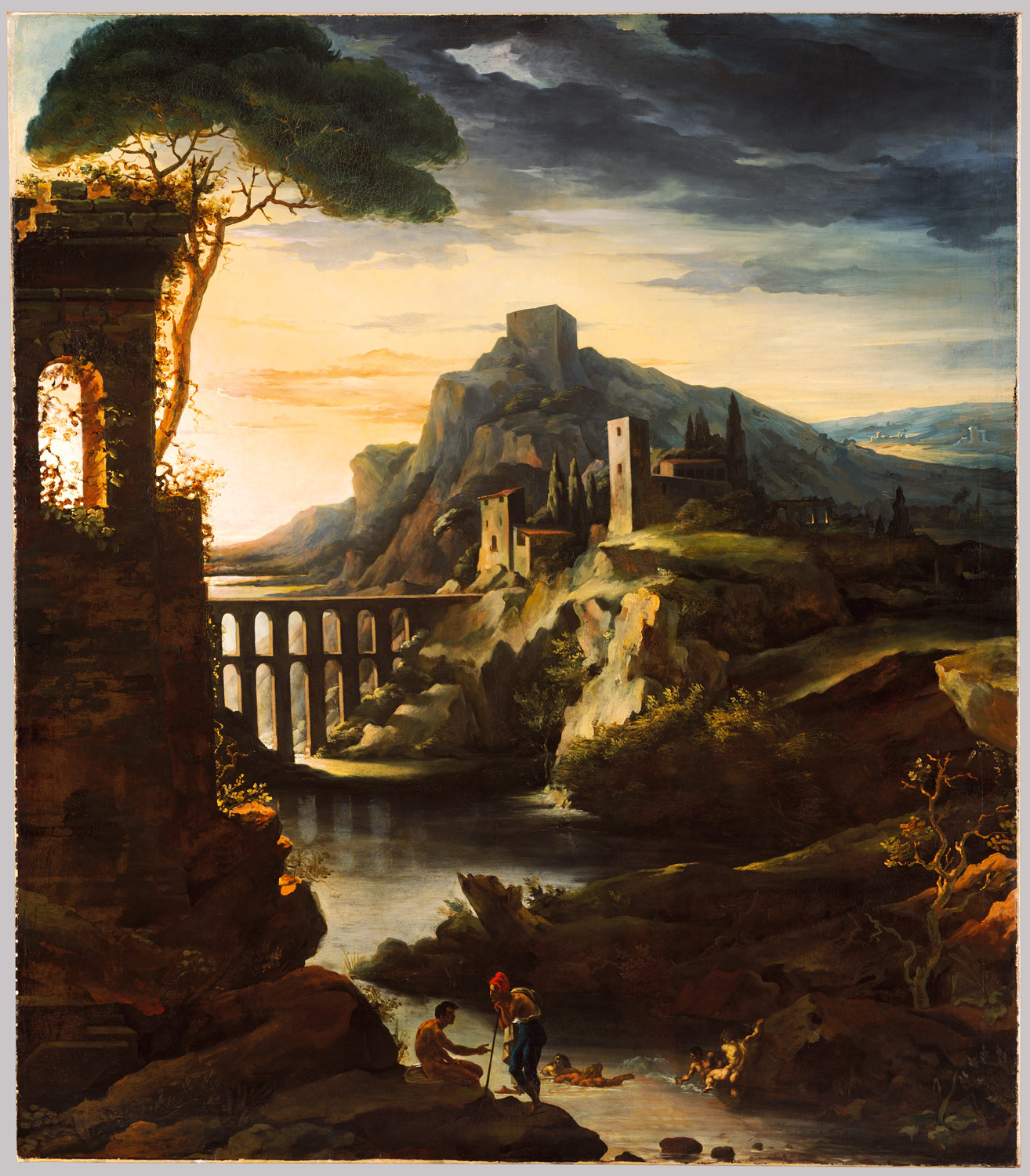
Evening: Landscape with an Aqueduct, 
    ArtistThéodore Gericault,Paintings
Théodore Géricault, Evening Landscape with an Aqueduct (1818)
Stormy sky, turbulent mood, overgrown ruins, human figures dwarfed by the immensity of the landscape: all elements of Romanticism.